
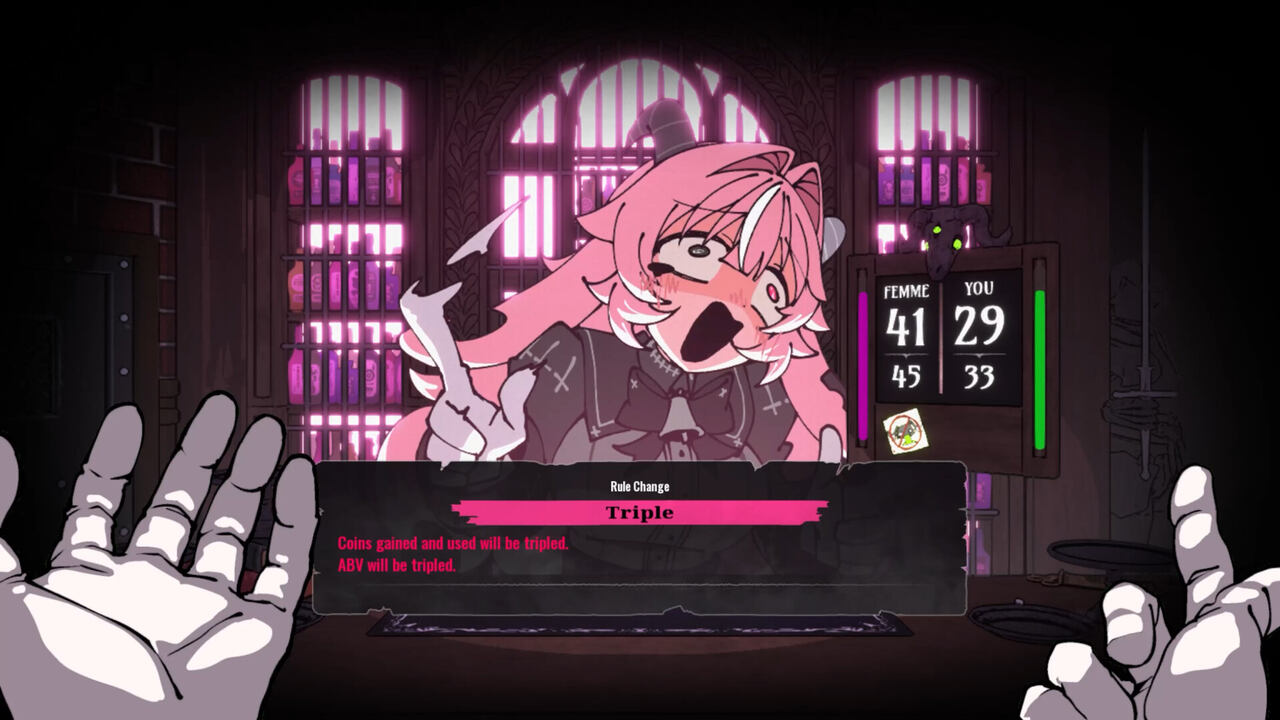
Femme Soule is the spelling: two words, a capital F, a capital S, and no accent on either. She is the demon of alcohol behind the bar in Drunken Goddess Reflux, and every other spelling on this page means her as well. If you arrived from fam sour, femme sol or femme soulle, nothing has gone wrong — you heard the name before you saw it written down.
The short answer to the usual question: there is one character, one spelling, and a handful of ways people type it. The rest of this page is those spellings, then who she actually is.
Every spelling you will see
| What you type | What it is | Why it happens |
|---|---|---|
| Femme Soule | The official spelling | Two French words with the accent filed off so it reads as a surname |
| femme soule | The same name in lower case | Search boxes ignore case; only the two capitals are house style |
| fam sour | Phonetic | Femme is read as "fam" and soule as "sour" by English speakers |
| femme sol | Truncated | Sol is a French word and a common name ending; the last letters get lost by ear |
| femme soulle | Doubled L | French feminines often end in -lle, and soulle looks more French than soule |
| femme soûle | The French phrase underneath | Soûle is the feminine of drunk; the circumflex is exactly what the title removed |
| ファム・スール | Katakana | The same name transliterated for the Japanese build, which keeps it in Latin script too |
| 梵·醺儿 | Chinese store name | An adaptation rather than a transliteration, built on 醺 — tipsy |
Every variant, one paragraph each
Fam sour is the most common way to get her wrong, and it is the most forgivable. Read femme with English vowels and you get "fam"; read soule the way soul is read and the R appears on its own. Anyone who has only heard the name spoken will type this, which is why it shows up in search suggestions at all.
Femme sol drops the last two letters and keeps the shape. Sol is a real French word — sun — and a familiar ending in names, so the mistake reads as plausible rather than sloppy. If a search for her returns nothing, this is the second spelling worth trying.
Femme soulle doubles the L. French feminine forms end in -lle often enough that the doubling feels correct, and the version with two Ls appears in forum posts written by people who were guessing at the spelling rather than copying it.
Femme soûle is not a mistake at all. It is the phrase the name was built from: femme plus soûle, drunk woman, with the circumflex removed so the result reads as a surname instead of a description. If you are looking for what the name means, this is the answer.
ファム・スール is the katakana rendering used in the Japanese build of the game. The character keeps the same Latin spelling on the Japanese store page, so Japanese players meet both forms at once and there is no separate name to learn for her.
梵·醺儿 is what the Chinese store calls her. It is not a transliteration — it is a two-character adaptation whose second character 醺 means tipsy, the same move as the French pun: name the demon after the state she stands for. In traditional characters the last glyph is written 兒, so 梵醺兒 is the same name.
What the name is doing
Femme is woman. Soule is one letter and one accent away from soûle, the feminine form of drunk. In a game called Drunken Goddess Reflux that is not a coincidence and not subtle: the demon of alcohol is named Drunk Woman, in French, with the accent filed off.
That choice tells you how the game wants to be read. A name in another language is a costume; a name that is a plain description in another language is a joke the character is not in on. She introduces herself as a surname and the surname is her sin.
What she wants
Most antagonists in this genre want something you have. Femme Soule wants something for you, which is worse.
Her position, as the store copy puts it, is that you are desperate to escape reality and would be happier living with her in Hell. She is not lying about the first part. The game starts from the assumption that a person playing a game about drinking away an evening has some distance from their life, and she builds her whole argument on it.
She proposes the contest as the way to settle the question. Win, and you go back. Lose, and she gets the eternity she was asking for. From her side that is a fair bet offered in good faith — she is confident you will lose, but she is not cheating to make it happen.
 Official media · Steam
What she does at the table
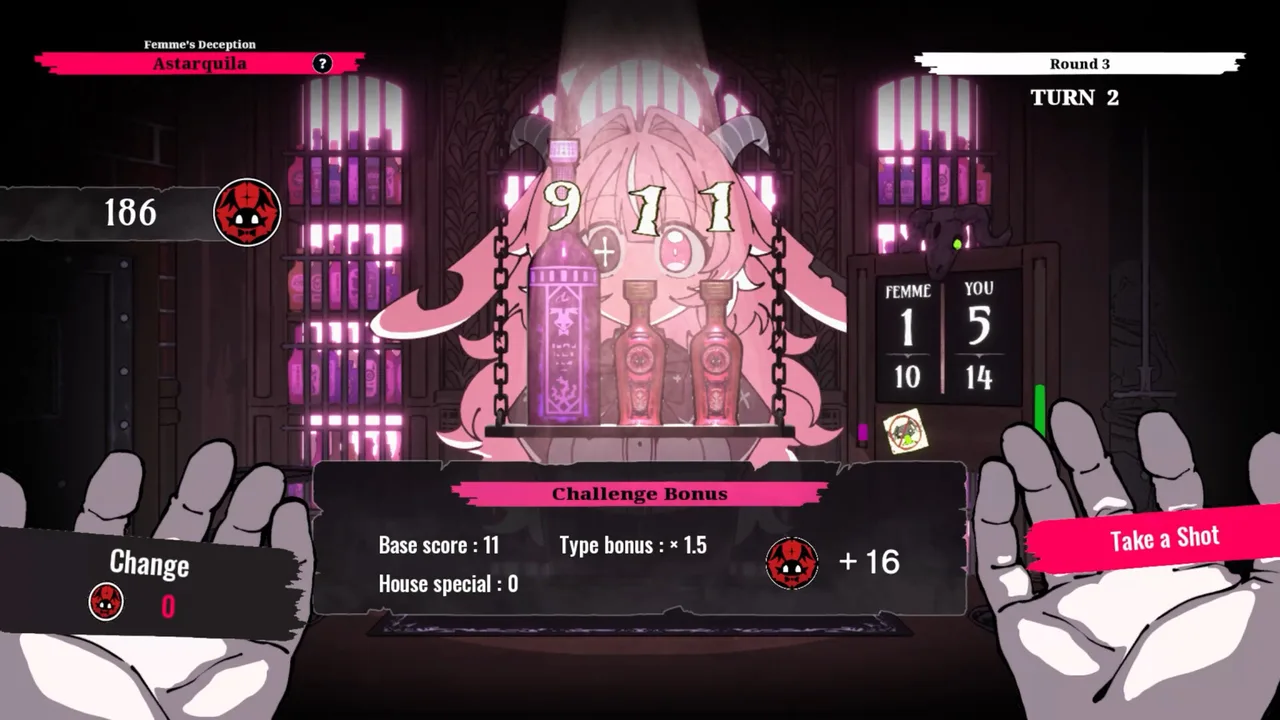
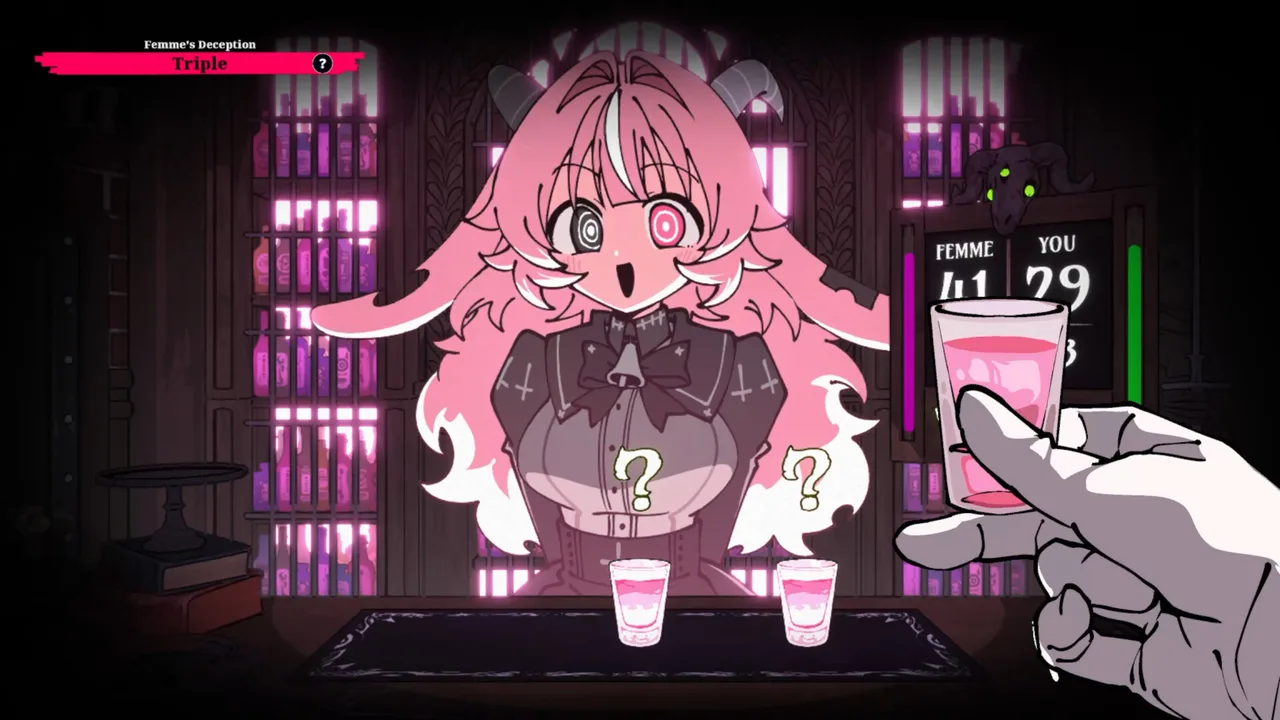
Femme is not a passive opponent waiting for you to fail. She plays from her own deck, and her cards are announced as hers: the corner of the screen carries Femme's Deception before the card name, and each one rewrites a rule. Triple triples coins gained and used. Astarquila is another, shown the same way.
So she is the game's rule engine as well as its antagonist. Every mechanical surprise in a run — the banner that drops mid-round telling you the economy just changed — is her doing, attributable to a named card she chose to play. That is a better design than a random event table, because it lets you learn her.
Over enough runs you should be able to read her patterns the way you read a dealer's up card. The material released so far does not show whether her deck cycles predictably, but the naming system implies it is meant to be learned rather than endured.
 Official media · Steam
Questions people ask about her
Is Fam Sour the same character as Femme Soule?
Yes. Fam sour is how the name is typed by people who have only heard it. The spelling on the store page is Femme Soule, and there is no second character.
Who voices Femme Soule?
Nanahira, credited as the game's voice. Japanese is the only full voice track, so every other language hears her performance with subtitles.
What does the name Femme Soule mean?
French for drunk woman — femme plus soûle, with the accent dropped so it reads as a surname. The demon of alcohol is named after the state she represents.
Is she the final boss?
She is the only opponent. There is no dungeon and no gauntlet; the whole game is one contest against her, which makes her both the antagonist and the entire difficulty curve.
Is she evil?
The game's framing is that she is in love. She offers a wager, keeps to it, and intends to honour the outcome either way. Whether that is villainy depends on how you feel about someone deciding what is best for you.
Why she carries the game
A single-opponent game lives or dies on whether that opponent is interesting after twenty runs. Femme Soule is built for that: she talks, she plays cards you can name, she has a desire that does not change and a method that does, and she is in every frame whether or not she is speaking.
The measure of whether it works is whether players start describing her the way they describe the dealer in a good card game — as a personality with habits, not as a difficulty setting. The naming system is the strongest sign the studio is aiming for exactly that.